blog
The Distance Between How You Lead and How You’re Experienced: A Conversation with Phyllis Sarkaria
The Distance Between How You Lead and How You’re Experienced: A Conversation with Phyllis Sarkaria
In this Expert Monday conversation, Mentessa founder & CEO Tina Ruseva sits down with executive coach Phyllis Sarkaria to talk about the gap every leader eventually runs into: the difference between how you intend to show up and how your team actually experiences you. Phyllis draws on more than 30 years in corporate leadership and HR — including her time as Head of HR and internal executive coach at Quidel Corporation — to unpack why this gap exists, why it grows as leaders rise, and what closing it actually requires. The conversation also previews her forthcoming book, Harvest: A Leadership Story (out September 8), the follow-up to her first book, Courageous Clarity: Navigating the Way Forward on Your Leadership Journey.
From HR leader to executive coach
Tina Ruseva: You used to be Head of HR at Quidel Corporation, coaching leaders internally even before you left the corporate world. What led you to coaching, and how did you come to make it your full-time practice?
Phyllis Sarkaria: It’s a bit of a funny story. When I left the corporate world, I was weighing whether to focus on consulting or go back into a growth story with a small organization — I’d loved helping build something from the ground up. While I figured out what was next, I started taking on consulting engagements, and very quickly clients started asking me to coach executives in their organizations. I’d done a lot of that at Quidel, but I thought: if I want to be serious about this, I should get certified. There are plenty of people offering coaching services — but how many are really good? I wanted the credentials and the education behind it, so I went through the Berkeley Executive Coaching Institute.
Once certified, I found a real passion for it, because when you help one leader become even better with their team, you impact so many lives. All of us have experienced the difference between working for a genuinely good leader and working for someone who thinks they’re a good leader but lacks basic self-awareness.
Why self-awareness is the real leadership gap
Tina: You’ve built your entire practice — and now your books — around the distance between how leaders think they come across and how they actually land with the people around them. Is that the core of your work?
Phyllis: Very much so. Most of us think we’re fairly self-aware. Tasha Eurich’s research puts it well: something like 95% of us believe we’re self-aware, and yet only 10–15% of us really are. Even those of us who think we understand our impact on others need ongoing development. It’s not like building muscle — you don’t get to “arrive” and stop. It takes maintenance and awareness.
For successful leaders specifically, that takes courage. Once you reach a certain level of success, everyone assumes you’ve arrived. It takes humility to say, “Maybe I don’t know all the answers — maybe what I know is actually getting in the way of learning more.” And then it takes discipline to keep doing that work. Those principles run counter to how we used to picture leaders: the ones who had to have all the knowledge, all the wisdom, and always project confidence.
Tina: With so much information now available at our fingertips, there should be more room for exactly these kinds of conversations in the workplace — where people get to be curious about each other instead of just having the answers.
The story behind Harvest
Tina: Your first book, Courageous Clarity, is a practical guide. Your new one, Harvest: A Leadership Story, takes a completely different form — it follows a manager close to burnout who’s forced to take a break and ends up in an olive grove in Italy. Where did this story come from?
Phyllis: People get the “puppy head tilt” when I explain it — what does olive picking have to do with leadership? My husband and I have spent over a dozen years helping friends with their olive harvest at an estate in southern Tuscany. As we picked alongside other people year after year, we’d get to know them — a bit like the openness you sometimes find talking to a stranger on a plane. We’d talk about what we each did professionally, and I started noticing out loud: “the concepts I talk about with leaders — here’s a similar behavior happening right here in the grove.” The more I did that, the more it stopped being a list of principles and became a story.
Tina: Stories are such a powerful way to inspire change — I thought of Who Moved My Cheese? while reading it. Harvest has that same quality, but with even more depth — almost a modern workplace fairy tale.
Meet Emily — and why she had to struggle first
Tina: The book’s protagonist, Emily, is a manager driven to get results “no matter what,” to the point where she becomes toxic to her own team. How did you build her character, and what were you trying to avoid?
Phyllis: So many of us recognize this. We’re being asked to do more with less, and even the promise that AI will replace people often means the people using AI end up working more hours. It’s a “crush it” culture. Emily bought so fully into getting results at any cost that she became toxic to her team — without ever intending to. Who hasn’t been there, as a manager or as a team member?
Tina: Her journey starts with an act of introspection — she makes a list, sitting on the plane, of everything that isn’t working. But do you think that list captured all of her problems?
Phyllis: No — and that’s the point. Even the most brilliant leader can’t know everything, especially as they rise in an organization: less information reaches you, simply by virtue of the role and everything on everyone’s plate. Making that list was just the start of Emily asking, “How did I get here, and where do I want to go next?” It required real introspection.
When she arrives at the grove, she brings her usual approach — go in, improve things, work faster, be competitive — and it doesn’t land well. The other pickers are amused by it, and they give her a hard time. That’s what starts to show her that this is exactly how she’s been behaving back at the office.
Why leadership needs other people in the room
Tina: Leadership is a team sport — you can’t practice it alone, and you can’t really get good at it alone either. Your supporting cast — Paul and Gail, the hosts, and fellow pickers Tommaso, Matteo, Deb, and Charlie — all end up functioning like coaches to Emily. Was that intentional?
Phyllis: One of my early readers pointed out that they all seemed like experienced coaches. That’s a device I leaned into, but it also reflects something true: everyone can potentially be a coach to you, if you open yourself up to hearing their story and thinking about how it might apply to your own.
Tina: That resonates strongly with what we’re building at Mentessa — organizations that are more collaborative, more cross-silo, where roles and skills are shared and rotated rather than hoarded.
The role of the coach — holding up the mirror
Tina: Of everyone in the story, you’ve said Paul is specifically “the coach.” Why give Emily a dedicated coach on top of peers who reflect the workplace back at her?
Phyllis: Having someone in your corner — who supports you, but who’s also willing to push and challenge you — matters enormously. Most of the leaders I work with have already been successful, and then they hit a point where the things that used to work stop working, or their strengths tip over into liabilities. Someone who holds up the mirror and asks, “Is this who you want to be? How’s that actually working for you?” and pushes you to think differently — that’s often what gets a leader unstuck enough to make the next leap.
Tina: I remember exactly that feeling in our own coaching sessions — you’d hold up the mirror, and inwardly I’d feel almost angry, until the light bulb finally went on: other people see me differently because they’re not standing in my shoes.
Three principles for closing the gap
Tina: If you had to name the three core leadership principles from the book — the ones you most want readers to take away — what would they be?
Phyllis: It comes down to how we close the gap between how we see ourselves and the impact we actually have on others.
1. Stay curious. The more curious we can be, the better — because our own knowledge and experience can get in the way of staying open to new information. This is often exactly why more senior leaders come across as less curious.
2. Build trust through visible change. You can genuinely change yourself, but if the people around you can’t see it, it won’t register. Our experience of another person is sticky — unless we see a real, sustained change rather than a one-time performance, we keep seeing them the way we always have. Don’t assume good intentions are automatically trusted; rebuilding and communicating that trust takes deliberate effort.
3. Listen to understand, not to respond. Good listening isn’t just staying silent while someone else talks. It’s asking questions that help the other person clarify their own thinking — paired with genuine curiosity, not the intent to prove you’re right or to check whether you’re missing something. This matters especially for leaders trying to re-engage a disengaged team: don’t try to convince people that what excites you should excite them. Find out what actually gets them out of bed in the morning — and remember that this can change over time, even for people you thought you already knew well.
Tina: And underneath all three is a fourth, almost meta-principle: where you put your time. When you’re racing as fast as possible, it’s easy to discard information that seems unimportant in the moment. Even short, intentional pauses — a ten-minute walk, or a few fully disconnected days — open people up to more innovation and creativity.
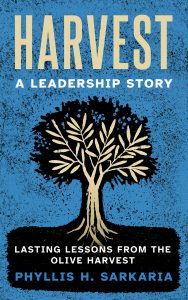
Harvest: A Leadership Story, the new leadership fable by executive coach Phyllis Sarkaria — available for pre-order now
Harvest: A Leadership Story — out September 8
Harvest follows Emily through three movements: displacement (stepping out of her role), growth (the work she does with Paul in the olive grove), and the “first press” — harvesting the results of everything she’s learned. It’s available for pre-order now ahead of its September 8 release, as the follow-up to Phyllis Sarkaria’s Courageous Clarity: Navigating the Way Forward on Your Leadership Journey. Pre-order here.
Phyllis Sarkaria is the founder of The Sarkaria Group and a certified executive coach with more than 30 years of corporate leadership experience across HR, government affairs, strategic planning, merger integration, and team effectiveness. Before founding her practice, she served as Head of HR and internal coach to C-suite executives at Quidel Corporation. Learn more at sarkariagroup.com